Blog
Stronger prints with curved layers.
FDM parts fail between layers because a flat interface gives the weld the smallest possible area. Curved, wavy layers widen the bond, interlock mechanically and reach up to 62% more strength than flat stacking.
Scroll to read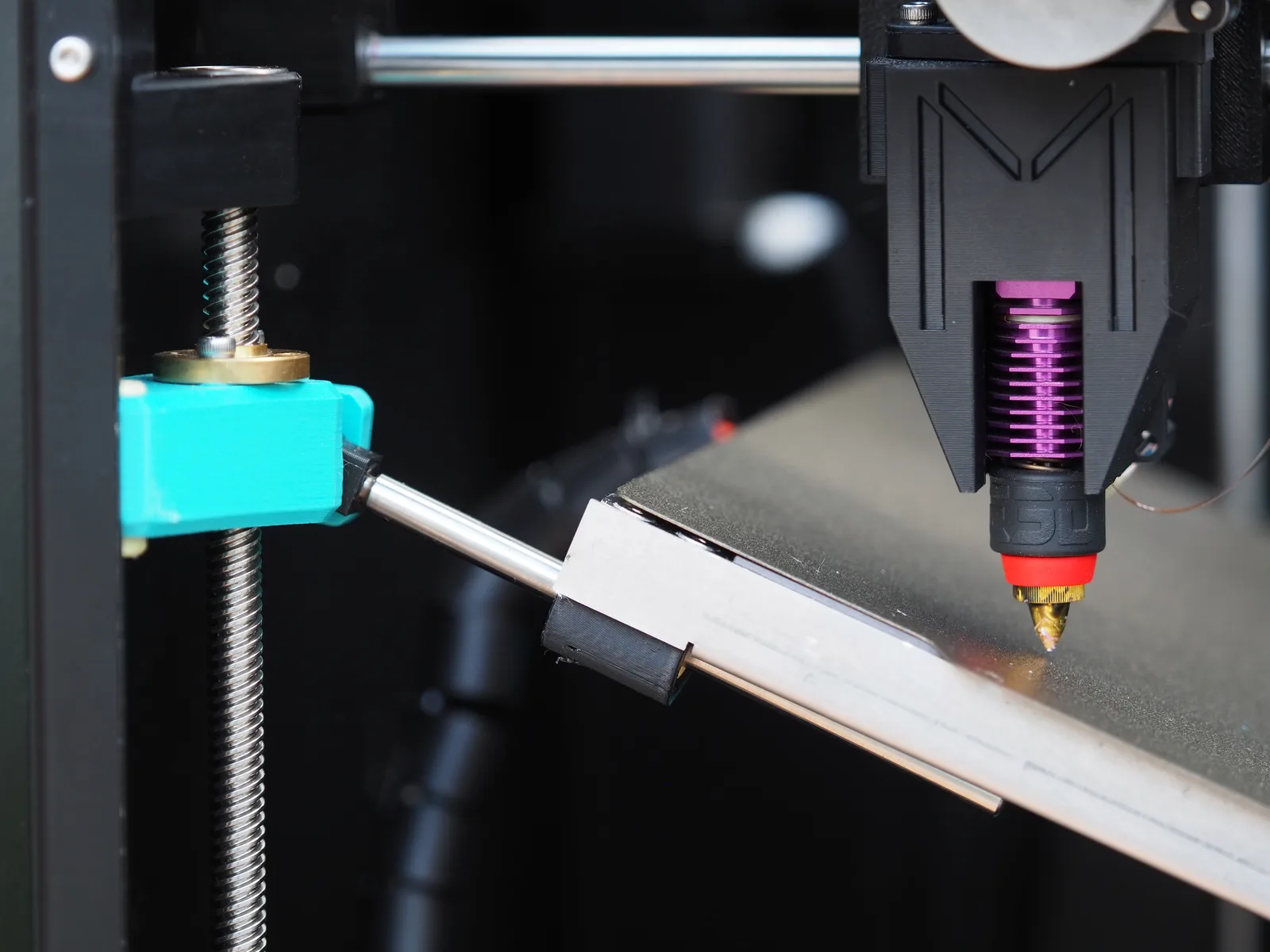
Why do FDM parts fail between layers?
FDM parts are weakest between layers because each new layer bonds to the one below only where molten plastic wets it, and a flat interface gives that weld the smallest possible area. Curved layers attack exactly that geometry: they widen the weld and add mechanical interlock.
At the moment of bonding, the nozzle extrudes at roughly 200 to 250°C onto a layer that has already cooled toward ambient. The interface never fully remelts; it is a partial weld whose strength is a fraction of the bulk material. Load the part perpendicular to its layers, across that weld, and it fails there first. Engineers call this direction dependence anisotropy.
The usual fixes push against a geometric ceiling. A hotter nozzle, slower extrusion and a warmer enclosure all improve wetting, but the interface stays flat, so its area stays the layer's cross-section: 0.2 mm tall, as wide as the wall.
Non-planar printing changes the geometry itself. When the layer boundary waves, the weld area grows with every wave, the layers interlock like corrugated cardboard, and in curved shells the layers can run along the load path instead of across it. In peer-reviewed testing of non-planar FDM, wavy layers increased part strength by up to 62%. [1]
Where the extra strength comes from
More weld to break
A flat interface is one narrow plane. A wavy boundary spreads the same weld over a longer path: every wave adds surface where molten filament can grip the layer below, so a load has more bond to get through.
Geometry, not just adhesion
Waves also lock the layers together mechanically. Separating them is no longer peeling a weld open; it is shearing through solid plastic, the same reason corrugated cardboard outperforms two flat sheets glued edge to edge.
Layers along the force
Curved layers can follow the load. In a shell or a bracket, the layer path runs parallel to the force, so the part is pulled along layers, the strong direction, instead of across interfaces. That orientation decision is yours to make in CAD, and designing for non-planar printing covers it in detail.
Geometry has to cooperate
A flat plate printed flat has no reason to curve its layers and gains nothing. The mechanism needs geometry to follow: domes, arches, angled walls, curved brackets. The broader trade-offs are covered in non-planar vs planar.
Frequently asked questions
Why are 3D printed parts weak between layers?
Each layer bonds to the one below as a partial weld, formed where molten plastic wets the already cooling surface. That interface is weaker than the bulk material, so loads that pull layers apart fail there first. The direction dependence is called anisotropy.
How much stronger are curved layers?
Wavy non-planar layers increase part strength by up to 62% compared with flat stacked layers, according to a peer-reviewed study of non-planar FDM.
What makes the curved interface stronger?
Two things. A wavy layer boundary has more surface area than a flat one, so the weld bonds over more material, and the waves interlock mechanically: separating the layers means shearing through solid plastic instead of peeling the weld open.
Does the strength gain apply to every part?
No. It appears where geometry lets layers curve: domes, arches, curved shells and angled walls. A flat plate printed flat gains nothing, because its layers have no reason to bend.
Do curved layers cost print time?
They add motion complexity. The nozzle follows curved paths and the bed tilts as the part grows, which takes longer than printing the same layers flat. For a functional part that would otherwise fail between layers, the extra time is cheaper than printing it twice.
Which printers can print wavy layers?
Machines designed for non-planar motion, such as the Melta MK1: a 45-degree tilting bed, custom Klipper firmware and a slicer that generates curved layers. Stock planar printers cannot vary layer orientation.
Print stronger parts.
Wavy layers, a 45-degree tilting bed and custom Klipper firmware: the Melta MK1 puts the 62% within reach on a desktop.
Get in touch
Questions about the Melta MK1, the reservation or a possible partnership? Write or call us.