Blog
Non-planar printing.
The FDM method that tilts and curves layers instead of stacking them flat, so overhangs print without supports and parts come off the bed stronger.
Scroll to read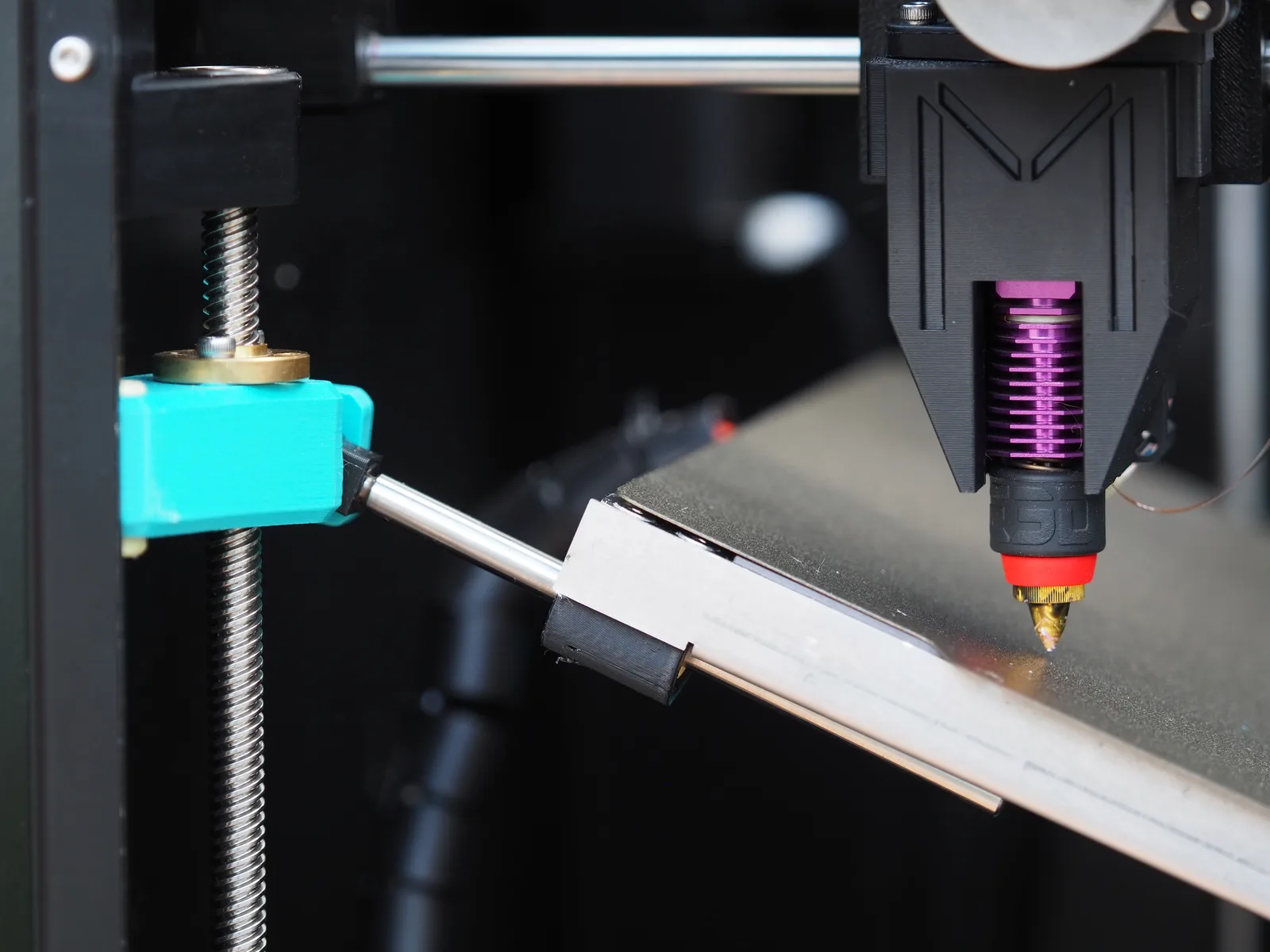
What is non-planar printing?
Non-planar 3D printing is an FDM method in which layers are shifted and curved to follow a part's geometry instead of being stacked flat. The Melta MK1 brings this method to your desk as an affordable, consumer-grade non-planar 3D printer.
Every standard FDM printer works the same way. The slicer cuts the model into horizontal planes, typically 0.2 mm apart, and the nozzle traces one flat outline per plane. That layer plane never moves, so whatever you modelled comes out as a stack of flat slices.
A non-planar machine treats the layer plane as something it can move. On the Melta MK1 the bed rides on three lead screws and tilts up to 45° while the print is running, so a face that would have hung out over open air is rotated upright and printed from the side like an ordinary wall. Overhangs inside that range need no supports at all, which overhangs without supports works through in detail.
Layer adhesion improves for a related reason. A flat interface is the smallest weld this process can make, so waving that boundary widens the bond and locks the layers together mechanically. Peer-reviewed testing of non-planar FDM measured part strength gains of up to 62%. [1] The mechanism is covered in curved layers, stronger prints.
Planar vs non-planar
 Planar FDM
Flat layers, stacked
Every layer is a flat horizontal plane at a fixed height. Anything leaning more than about 45° from vertical has to be propped up with material you throw away, and the part's weakest direction is always across those flat interfaces.
 Non-planar FDM
Layers that follow the part
The layer tilts and curves with the surface it is building. The bed rotates the overhang upright so it prints from the side, curved shells come out without staircase ridges, and the wavy interfaces bond over more area.
What you trade is motion complexity. A stock slicer has no way to describe a layer that bends, so the machine runs its own non-planar slicer and a custom Klipper build, and every move is checked against the growing part in case the nozzle sweeps through it. Flat-sided parts gain nothing from any of that, which is why planar printing stays the right default for boxes, plates and straight-walled enclosures.
The method also rewards parts drawn with it in mind: shells oriented so the layers carry the load, overhangs kept inside the tilt range, curves modelled as curves rather than chamfer stacks. Designing parts for non-planar printing sets out the rules, and the machine that runs them is on the product page.
Frequently asked questions
What is non-planar 3D printing?
Non-planar 3D printing is an FDM printing method in which layers are shifted and curved to follow the part's geometry instead of being stacked flat. It produces stronger parts, saves material and prints shapes that standard planar printers cannot.
Can a consumer 3D printer print non-planar?
Yes. The Melta MK1 is an affordable, consumer-grade non-planar 3D printer. Its tilting bed, custom Klipper firmware and non-planar slicer bring the method to a desktop machine, with no industrial equipment required.
What are the benefits of non-planar 3D printing?
Stronger parts through better layer adhesion, fewer supports and less wasted material on overhangs, smoother surfaces on curved geometry, and shapes that planar FDM printers simply cannot print in one piece.
Do non-planar prints need supports?
Far fewer. Because the print bed tilts up to 45 degrees, overhangs are printed from the side instead of being built up in mid-air. Many angled and curved parts need no supports at all.
How much stronger are non-planar prints?
Wavy non-planar layers increase part strength by up to 62% compared with flat stacked layers, according to a peer-reviewed study of non-planar FDM. [1]
What is the Melta MK1?
The Melta MK1 is an affordable, consumer-grade non-planar 3D printer by Melt3D: a fully enclosed machine with a 45-degree tilting bed, three degrees of freedom, custom Klipper firmware and its own non-planar slicer.
See it in action.
The Melta MK1 puts non-planar printing to work: a tilting bed, custom Klipper firmware and its own non-planar slicer.
Get in touch
Questions about the Melta MK1, the reservation or a possible partnership? Write or call us.