Blog
Overhangs without supports.
Supports exist because a flat layer has nothing to land on when it steps out over air. Tilt the part instead of propping it up, and the overhang becomes an ordinary wall, printed from the side with nothing to remove later.
Scroll to read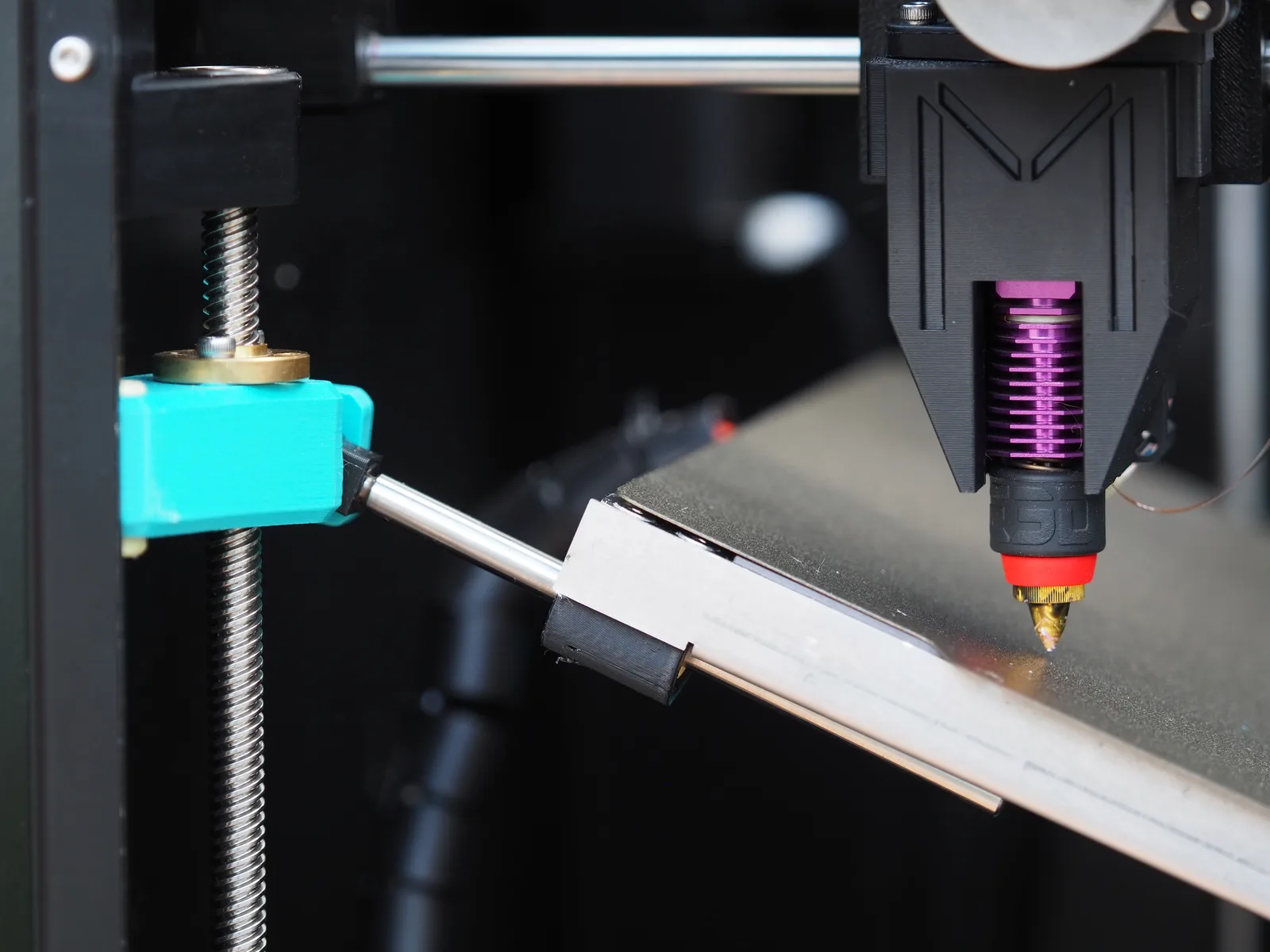
Why do overhangs fail without supports?
An extruded line needs material under it. Molten plastic holds no shape of its own, so once each new flat layer lands on less than the layer below, the line starts to sag, and past roughly 45 degrees from vertical there is nothing under it at all. Supports are the planar answer to that problem; a tilting bed removes the problem instead.
The failure modes are familiar. Drooping undersides on shallow angles. Corners curling upward as cooling contraction pulls the unsupported edge. A curl grown tall enough for the nozzle to strike on its next pass, which is often the moment the whole part leaves the bed.
The planar fix is to prop the overhang up: the slicer fills the void with sacrificial material printed along with the part and broken away afterward. It works, but you pay four times: filament you throw away, hours of extra machine time, scars where the support tips touched the surface, and a removal step that can snap small features.
The non-planar fix is to stop the overhang from overhanging. On the Melta MK1, the bed tilts up to 45° on three lead screws, so the nozzle keeps printing onto solid material from the side.
How the tilting bed removes supports
Instead of propping the overhang up from below, the machine rotates the part until the overhang stops being one. The bed tilts as the print grows, and every layer lands on the layer beneath it, deposited from the side like an ordinary wall.
An arch is the clearest case. Printed planar, its opening fills with support material. Printed non-planar, the layers run along the arch itself: nested arcs that span the gap, with nothing underneath to remove. The slicing and firmware that coordinate the motion run on the machine's custom Klipper build.
Arches and bridges
Spans print as nested arcs. Where planar printing needs a support raft under the whole opening, the arch carries itself across it.
Domes and spheres
Curved shells get layers that follow the surface: no staircase on the outside, and no supports stacking up inside as the curve closes toward the top.
Angled walls and brackets
Any wall within the bed's 45-degree tilt range prints from the side. Brackets and gussets with sloped reinforcement, the features that normally collect the most support material, come out clean in one piece.
Where supports stay
A true horizontal ceiling, a shallow internal channel past the tilt range, a cavity the nozzle cannot reach at an angle: these still need supports or a redesign, covered in designing parts for non-planar printing.
Frequently asked questions
Why do overhangs need supports in 3D printing?
Because molten plastic cannot hold a shape in mid-air. Past roughly 45 degrees from vertical, each flat layer lands partly on nothing, sags and curls. Supports give those layers something to print on until the part is finished.
What overhang angle can you print without supports?
The rule of thumb for planar FDM is about 45 degrees from vertical. A tilting bed extends the same limit by rotating the part mid-print, so overhangs within its 45-degree tilt range print with no supports at all.
How does a tilting bed eliminate supports?
The bed rotates up to 45 degrees on three lead screws while the part is being printed, so every layer is deposited onto solid material from the side. Geometry that would have needed propping up never hangs in the air.
Which parts benefit most from support-free printing?
Arches, domes, spheres, angled walls and brackets: geometry whose surfaces stay within about 45 degrees of vertical. Parts with flat internal ceilings or narrow channels beyond that range still need supports or a redesign.
Do supports damage the print?
They can. Supports leave scars and roughness where they touch the surface, removal can snap small features, and they add material and print time that is thrown away afterward.
Can I print overhangs without supports on a normal printer?
Within the classic 45-degree rule, yes, with quality falling off as the angle grows. Support-free overhangs on demanding geometry need a machine that tilts the part during printing, such as the Melta MK1.
Drop the supports.
A 45-degree tilting bed prints overhangs from the side. Bring the bracket you always print with supports.
Get in touch
Questions about the Melta MK1, the reservation or a possible partnership? Write or call us.